When it rains, it pours.
Laozi spends a great deal of time thinking about water. Water yields. It moves around obstacles. It finds the low places. It does not waste much energy arguing with rocks. I have been thinking about that lately.
It has been a difficult few months — magnificent in places, ridiculous in others, frequently exhausting. Life apparently saw no reason these things could not happen simultaneously.
This summer I travelled thousands of kilometres west from Chongqing into Xinjiang and along the old Silk Road, through deserts, mountains and long highways disappearing toward the horizon. It was the kind of landscape that makes a man reconsider several of his previous complaints. It also gave me too much time to think.
I started asking myself harder questions, and some of them followed me home.
There were difficult things happening in my private and family life that I was still trying to understand. Some changes I expected. Others arrived without knocking. For a while, things that had seemed fixed began looking considerably less fixed.
So I did what I tend to do when life becomes difficult: I kept making things.
In Xinjiang I wrote a new album, Babel.exe (Silk Road Bass), born partly out of that enormous landscape and the feeling of moving through a part of the world that has carried travellers, traders, armies, pilgrims and stories for thousands of years. I also wrote another strange little project called Dopa Machine, loosely inspired by Peter Pan and my suspicion that some of his behaviour might be better explained by dopamine than fairy dust.
Apparently my preferred response to an existential crisis is still to make records.
I also started rebuilding myself more literally. I ran. I lifted. I lost a substantial amount of weight and started getting stronger than I had been in years. When the philosophical questions became too large, I lifted something heavy. Gravity is reassuring that way: it is not interested in your interpretation of events. Either the weight moves or it doesn’t.
Mine started moving.
Arguing With the River
When I returned to Chongqing, home was unusually quiet for a while. That gave me more solitude than I had experienced in years, and solitude has a nasty habit of removing the background noise. I thought about my teaching, my writing, my family, the choices I had made and the choices I might still have to make. I thought about what kind of life I wanted to build from here.
There were no immediate answers. This was inconvenient.
I have always had a Stoic streak. Marcus Aurelius and company are useful when circumstances refuse to obey instructions. But lately my thinking has been drifting east. The head of my school had encouraged me to spend more time with Laozi and the Tao Te Ching, and the recommendation turned out to be better timed than either of us probably understood.
Stoicism had taught me to endure what I could not control. Taoism was beginning to suggest that I might stop trying to control quite so much of it. Move when there is room to move. Wait when there isn’t. Stop demanding that the river explain where it is going.
I began to suspect that some of my suffering came not only from what was happening, but from arguing with realities that had already arrived. So I started slowing things down: Tai Chi in the morning, running, breathing, speaking more slowly, and, perhaps most dramatically, considerably less coffee.
For years caffeine had been one of the structural supports holding up the Jorah Kai operating system. But if I wanted to quiet my nervous system and stop behaving as though every Tuesday afternoon were a minor emergency, pouring industrial quantities of stimulant into myself every morning seemed counterproductive.
I quit for a while.
The result was peaceful. Also foggy.
I was about to discover whether I could remain articulate, entertaining and professionally useful while operating on approximately zero caffeine.
An Extremely Inconvenient Invitation
The new school term began with Chongqing still running at around 38 degrees Celsius, the sort of weather that makes going outside feel like stepping into someone’s mouth. I had completed roughly three and a half days of teaching when an invitation arrived: would I like to go to Yangquan, Shanxi, for the Fourth Liu Cixin Hometown Science Fiction Culture Week?
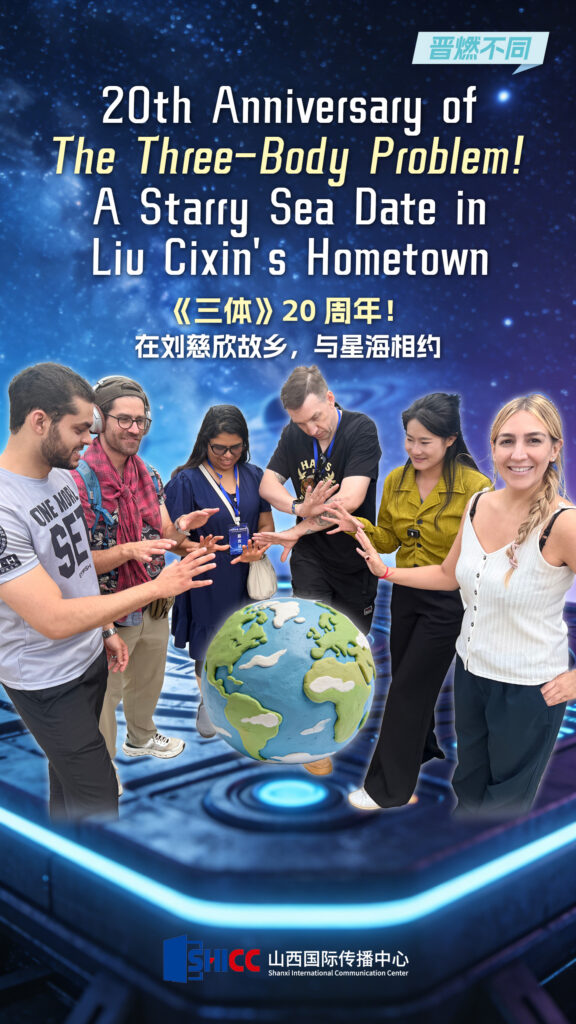
The event marked twenty years since The Three-Body Problem began its journey and would bring writers, translators, publishers, scholars and international guests to Liu Cixin’s hometown, which was increasingly embracing science fiction as part of its cultural identity.
It sounded amazing. It also sounded professionally absurd. This was the second week of school.
So I gave the organizers a simple answer: make the case to my school. Write a beautiful letter. Explain why this matters and why I might actually be useful there. If my school gives me permission, I’ll come. If they say no, then I am a teacher and I should probably teach.
They sent the letter. My friend Catherine, my literary agent and the head of a local news organization in Chongqing, called the school personally. Not long afterward, she messaged me.
Approved.
I could go.
Apparently the universe had spoken.
Packing for the Future
Suddenly I was packing jeans, which was exciting in itself. Chongqing was an oven, while Shanxi was forecast to be cool enough for an umbrella and an old cyberpunk jacket I had picked up in London years earlier and eventually received in Paris.
That jacket carries good memories. Some clothes become clothes; some become evidence that earlier versions of you really existed.
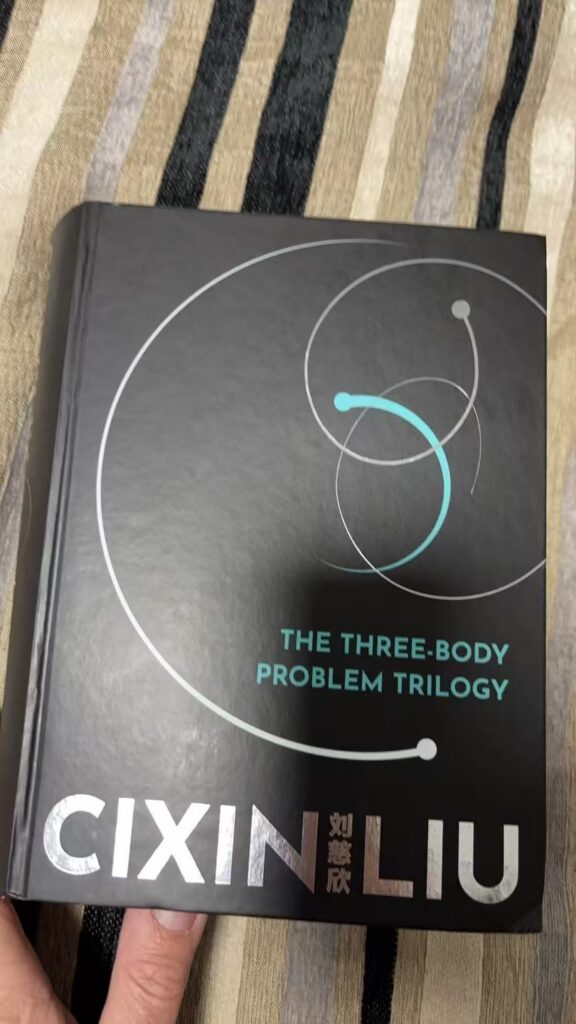
Into the suitcase went copies of Amos the Amazing in English and Chinese in case I was asked to read. Then came the heavy artillery: a massive black hardcover edition of The Three-Body Problem trilogy. It weighs several pounds and looks less like a science-fiction novel than scripture recovered from a civilization that has already replaced us.
The science-fiction Bible. I packed it too.
On Sunday, before leaving, I had one of those family days that arrive exactly when you need them. I spent much of the day with my granddaughter. We played. I held her. I went to bed feeling full in a way that had nothing to do with food.
Monday morning I was determined to begin the trip correctly: Tai Chi, stretching, a run. Slow down. Breathe. Embrace the Tao. Then, while waiting outside a barber shop, my father sent me a message.
Are you on the way?
On the way where?
I checked the flight information. I had been under the impression that my flight departed around three in the afternoon.
It did not. It landed around three. It departed around one.
I had spent the morning contemplating non-action. The Tao, apparently satisfied that I understood the theory, moved directly to the practical examination.
I ran home, grabbed the suitcase, called a car and headed for the airport. Everything worked: no catastrophe, no missed plane. Just reality changing suddenly and me responding to what was actually happening rather than what I had imagined was happening.
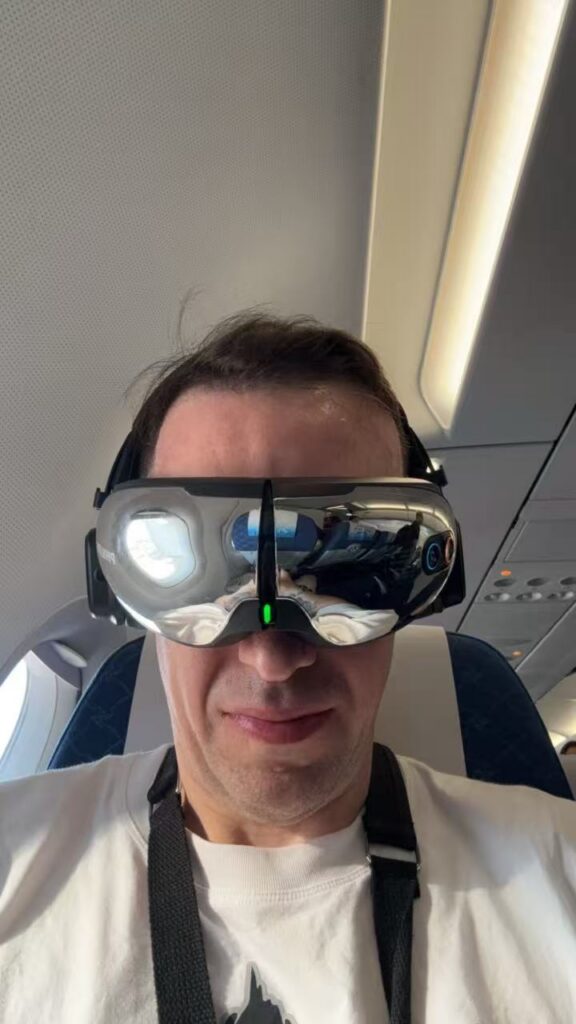
There was probably a lesson in there somewhere. An hour and a half after takeoff, we landed in Taiyuan, then drove on to Yangquan. The temperature had dropped, the jacket came out, and so did my brain.
Yangquan
The international group was an interesting mix of writers, translators, media people, experts and science-fiction enthusiasts from several countries. My interpreter, Jia, had excellent English, a quick sense of humor and the useful talent of making complicated situations feel uncomplicated. Monday was mostly arrival: hotel, dinner, introductions, sleep.
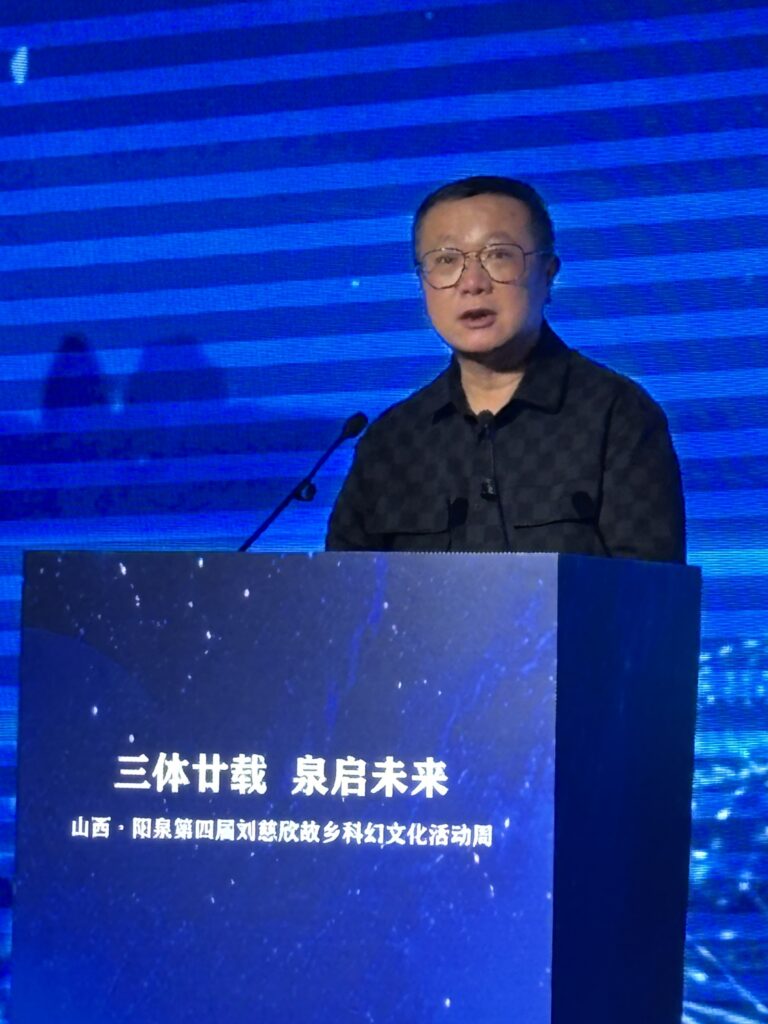
Tuesday morning was the formal opening ceremony, with officials, speeches, cameras, photographers and all the machinery surrounding a major cultural event. Then Liu Cixin walked onto the stage.
The room changed.
Twenty years earlier, Liu said, science fiction in China had still been a minority interest, with fewer readers, fewer writers and less room for creative work. Now his hometown was hosting an international celebration around the genre, and Yangquan had embraced science fiction as part of its public identity. Liu himself described the city in a wonderfully simple line:
“Yangquan is a home for my soul.”
He has the gravitational pull of a rock star.
The funny part is that he does not appear especially interested in being one.
Later, when we talked about all the attention surrounding him, he described the experience in terms considerably closer to disaster than triumph. That made me like him more.
The Man Behind Three-Body
I had met Kelly the night before. She was part of the team behind Liu’s international rights and the long process of carrying his work into publishing markets around the world. That fascinated me for another reason: Tor was one of those names I had seen on science-fiction and fantasy books since I was young, so meeting people involved in bringing Liu’s work into that publishing world felt strangely full-circle.
When Kelly hesitated to go over and greet Liu with everyone watching him, I nudged her. “Go say hello.” She did, and then I went over too. I reminded Liu that we had met three years earlier at WorldCon in Chengdu and mentioned our mutual friend, Robert J. Sawyer.
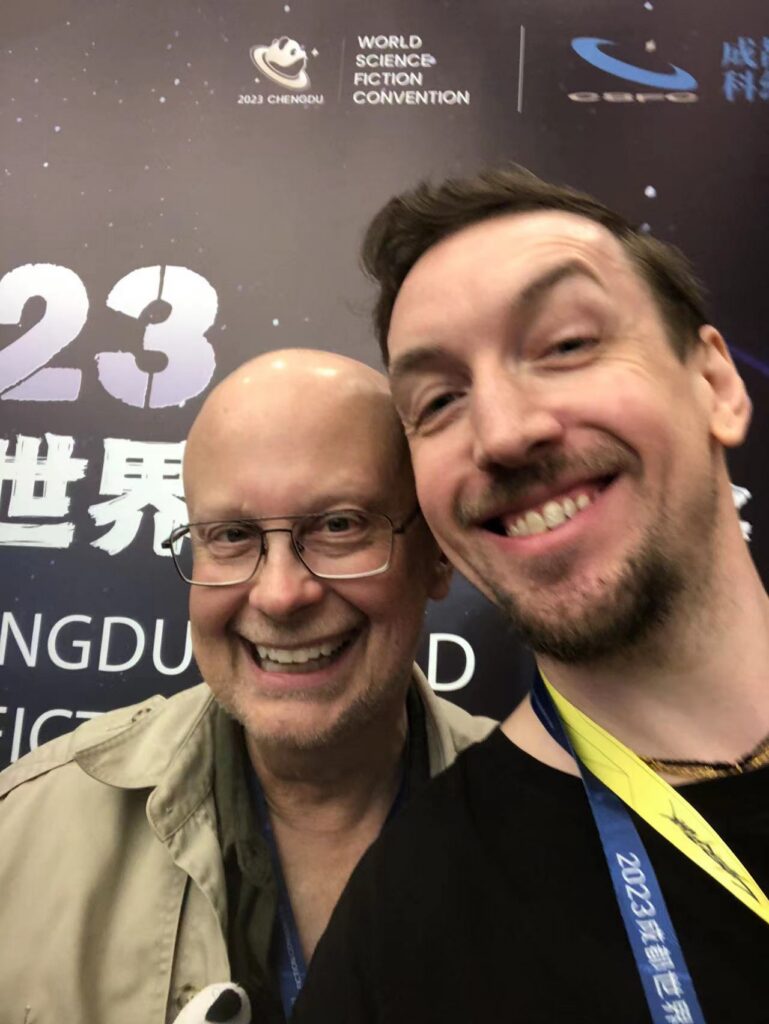
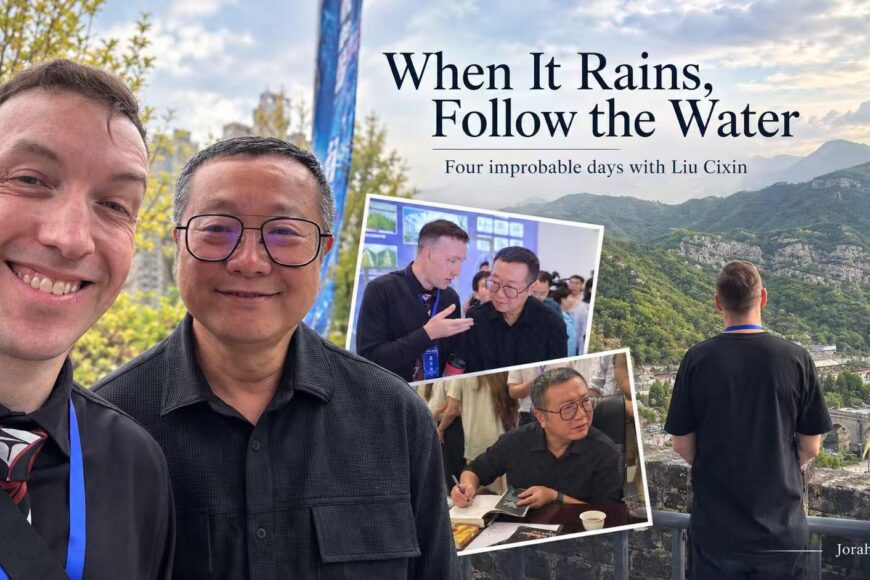
Liu smiled and we shook hands. Later, as we moved between buildings and events, he approached me again about Robert, and we took a selfie to send him. That small bridge changed the texture of the day. I was no longer simply standing near a famous writer at a conference.
We were talking.
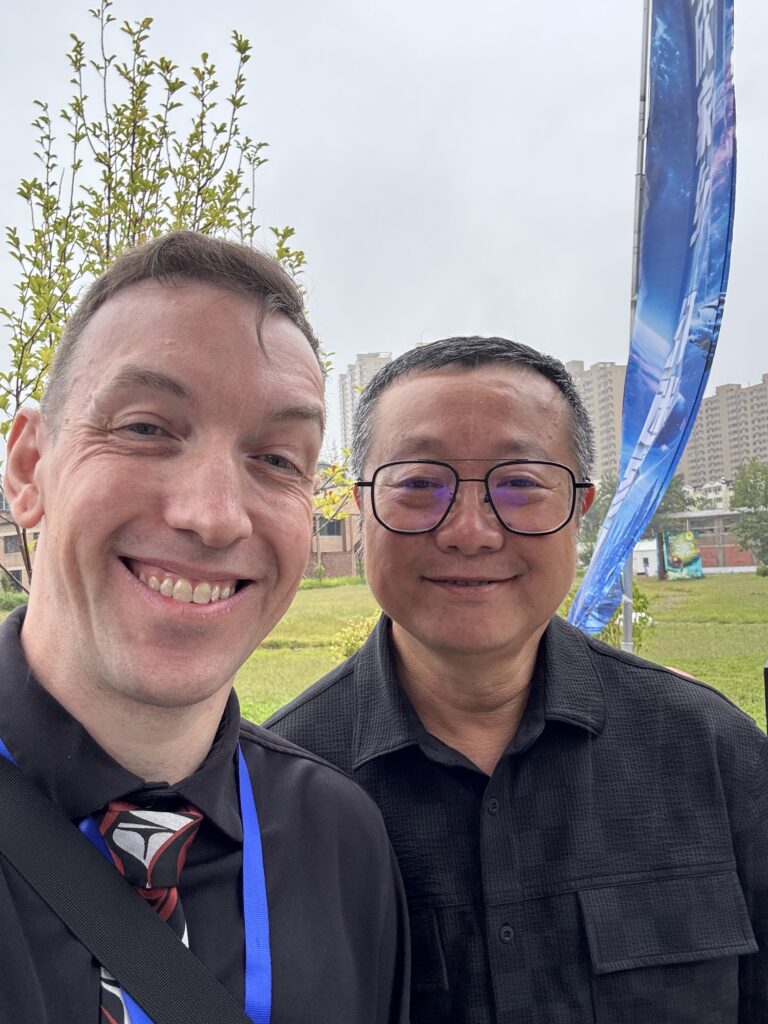
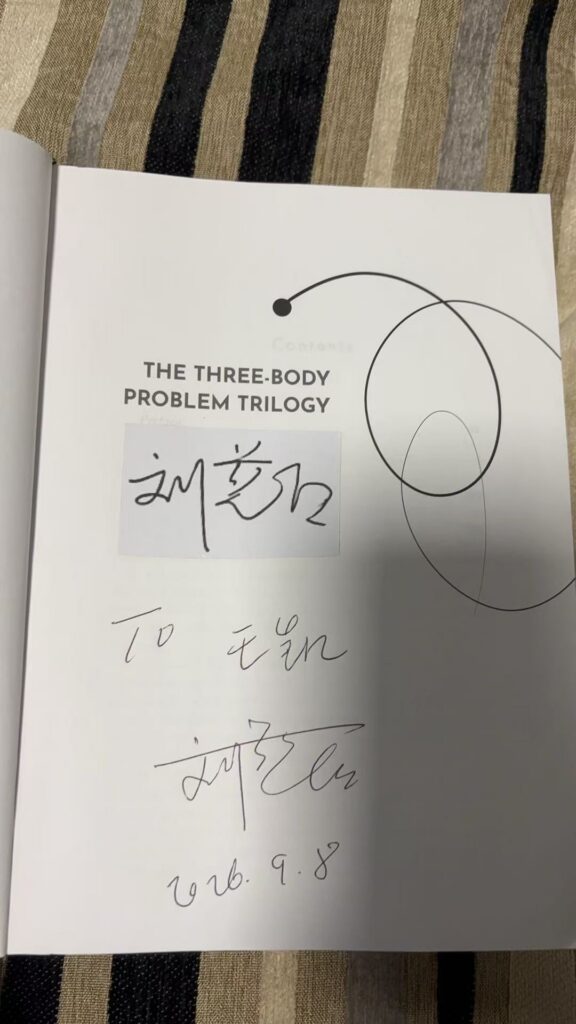
Later, Liu had clearly reached his daily saturation point with cameras, crowds and being Liu Cixin, and headed for his car. Somehow I ended up going with him long enough to get the enormous black Three-Body book signed. He signed it to my Chinese name, Wang Kai.
The science-fiction Bible had completed its pilgrimage.
More Tea
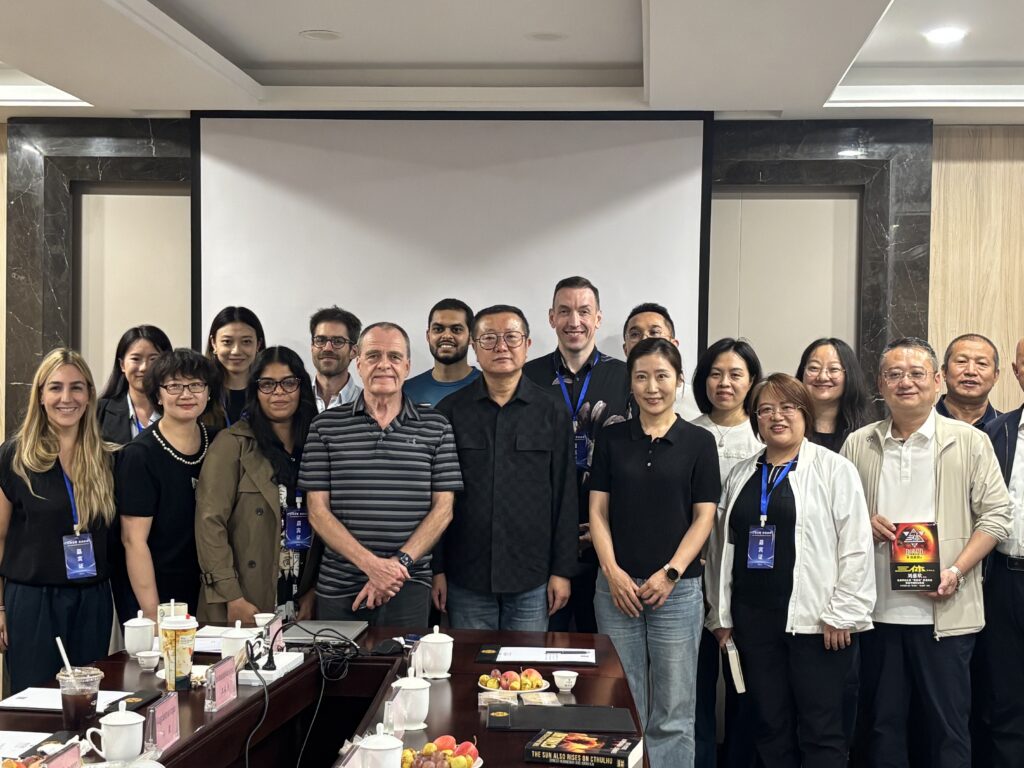
That afternoon we had something better than another formal ceremony: a small group of international guests spent about an hour with Liu behind closed doors over tea, fruit and conversation. No giant stage. No thousands of eyes waiting for him to say something profound.
I passed along greetings from Robert. Liu replied in English, and we talked. The atmosphere was warm and relaxed. I gave him a signed copy of my own novel, The Sun Also Rises on Cthulhu, and then I was given a Chinese set of his trilogy for my granddaughter.
She is two.
Liu signed them for her.
I hope someday, when she is old enough to understand what those books are and how they came to be in her hands, she will appreciate the strange route they travelled. Her grandfather carried them to the hometown of the man who wrote them, and the man wrote her name inside.
Where the Stars Came From
Over the next couple of days we saw more of Yangquan. We visited industrial sites, cultural spaces and mountain scenery. One stop was Yangquan Valve Co., an industrial facility also visited by President Xi Jinping during his 2025 trip to the city.
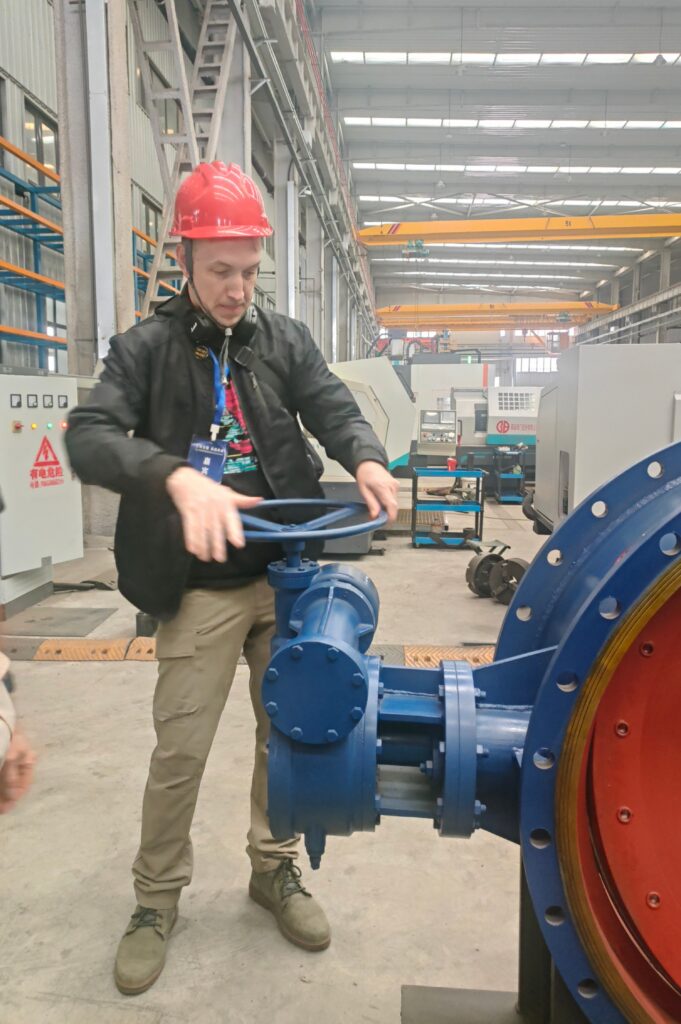
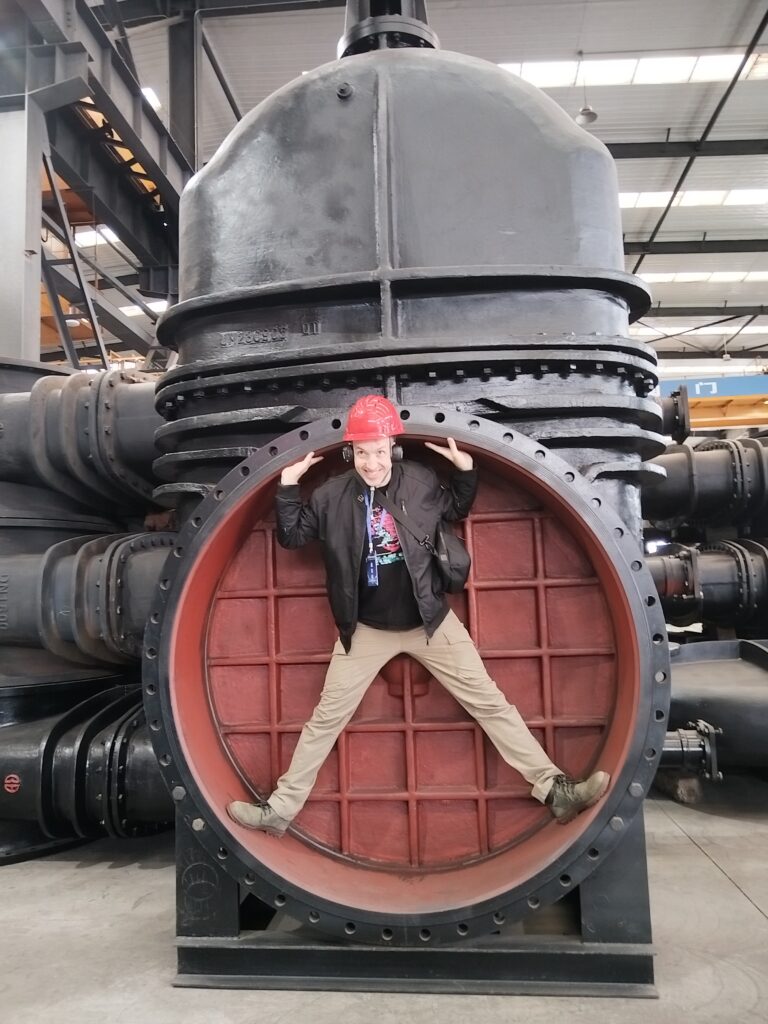
There was something wonderfully appropriate about standing among machinery while thinking about Liu’s fiction. Yangquan is a city shaped by coal, power generation and heavy industry, and Liu himself spent years working as an engineer. Somewhere inside that practical industrial world, someone was imagining alien civilizations, chaotic star systems and the long future of humanity.
Liu described science fiction during the conference as more than fantasy: imagination grounded in science, and a clear-eyed way of thinking about humanity’s future and technological development.
The cosmic did not emerge despite the factory. Maybe it emerged partly because of it.
Somewhere Along the Way, We Started Dancing
Not every moment required philosophical interpretation. Thank God.
At one old-town visit, we were dressed in Hanfu-style clothing and pulled into a dance with local grandmothers and grandfathers. The music continued. And continued. And continued.
At some point, the experience ceased to be cultural programming and became an endurance sport.
Somewhere in Shanxi there may still be an elderly woman wondering why an enormous Canadian dressed in historical Chinese clothing was dancing beside her with the grim determination of a man trying to survive a wedding reception.
We were sweating by the end, but we were also laughing. It was joyful, and those moments mattered too.
So did the quieter ones. At an international reading event, I read from Amos the Amazing alongside guests from several countries. It was warmly received, which meant a lot to me. In a week dominated by Liu Cixin and the enormous scale of The Three-Body Problem, it felt good to stand up and offer a small piece of my own imagined world.
One Question
The days went quickly. Much of the conference understandably looked backward: twenty years of The Three-Body Problem, Liu’s career, and the extraordinary international rise of Chinese science fiction. But Liu kept turning the conversation toward the people who would come next.
“The future of Chinese science fiction will ultimately depend on generation after generation of writers keeping their feet firmly on the ground, continuing to explore, and creating science-fiction works with greater individuality and greater power,” he said.
That caught my attention not only as a writer, but as a teacher. Most weeks, I spend much more time standing in front of students than sitting beside internationally famous novelists. My students are growing up in a world where artificial intelligence can answer questions instantly, technologies change faster than curricula, and many of the jobs they will eventually do may not yet exist. Somewhere in my bag were books signed for a two-year-old girl who has almost her entire life ahead of her.
So when I had a chance to ask Liu one question, I used it on them: what advice would he give young people preparing for a technological future none of us can reliably predict?
His answer was simple.
“The future is difficult for any of us to predict, so we should do our best to develop our imagination and consider all the different possibilities the future may hold. Then we should try to prepare ourselves to adapt to those possibilities.”
I wrote that answer down for my students.
Only later did I realize how badly I needed it myself.
Back Down the River
By Thursday night I was flying back to Chongqing. Four days, that was all, but it felt longer. Not because the trip had solved anything. It hadn’t. I still had questions waiting for me at home: school, relationships, decisions that would eventually have to be made, a body I intended to keep rebuilding. My father was coming to visit, National Day was approaching, hockey season was starting, and there was also a novel waiting.
I have a draft of the next Amos book, tentatively titled Amos 2: Edge of Chaos. It is darker than the first one, more mature, and given the circumstances under which I am editing it, that seems appropriate.
I still don’t know exactly what my life will look like a year from now. Some days I think about making large changes. Other days, the safety of keeping everything familiar feels extremely attractive. For someone who has spent much of his life anticipating the next deadline, class, trip, book, problem or possible disaster, uncertainty has never been particularly comfortable.
But I am starting to understand that uncertainty is not the same thing as catastrophe.
I did not come home with my life solved. I came home a little less convinced that it had to be.
Liu Cixin, of all people, did not tell me how to predict the future. He told me to imagine several futures, prepare for them, stay flexible and adapt. Laozi might have phrased it differently, but I suspect he would have understood.
Water does not know the entire route to the sea. It keeps moving.
So, for now, that is the plan: keep teaching, keep writing, finish Edge of Chaos, lift heavy things, spend time with the people I love, drink considerably less coffee, and when the river turns, try not to waste all my strength demanding that it straighten itself out.
The future will arrive when it arrives.
I’ll meet it there.